

The recently published 2026 Assessment Redesign Framework for higher education in Ireland, authored by Dr Hazel Farrell, Academic Lead for GenAI at SETU, offers a timely and thoughtful response to one of higher education’s most pressing questions “How should assessment evolve in the age of generative AI?”. Developed as part of the GenAI:N3 strand of Ireland’s national N-TUTORR project, the framework argues that the answer is not stronger detection, but stronger design. It calls on higher education institutions to rethink assessment in ways that make learning visible, valid, fair, transparent, and aligned with intended outcomes.
In this blog post, we look at what the framework means in practice and why its direction is especially relevant to Portflow (The Student-Owned Learning & Assessment Portfolio). Rather than treating assessment redesign as an abstract policy discussion, the focus here is on how the framework’s emphasis on visible learning, process, reflection, authentic demonstration, and programme-level coherence connects to the kinds of assessment environments higher education institutions are now being asked to create.
Why does assessment redesign matter now?
Generative AI has pushed assessment in higher education into a new phase. As tools such as ChatGPT, Claude, and Gemini have become widely accessible, familiar formats like essays, unsupervised exams, and online quizzes are coming under greater pressure and no longer offer the same level of assurance of learning as before. The Assessment Redesign Framework responds to this reality directly, arguing that higher education can no longer rely on older assumptions about how student work is produced and evidenced.
Assessment Type |
Level Of Risk |
Risks Posed by GenAI |
Mitigation Steps |
|---|---|---|---|
| Essays and Written Assignments | HIGH | AI can generate high-quality written content that may not be easily detected as non-original. | Require drafts and peer review, with oral follow-up to verify understanding. |
| Unsupervised Open-Book or Remote Exams | HIGH | Students might use AI to complete their exams, leading to misrepresentation of their own knowledge. | Use time limits, combine with in-person assessment, and randomise or personalise questions. |
| Online Quizzes | MEDIUM | AI can assist in answering questions, especially multiple-choice ones, if they are available online. | Use question banks to randomise questions, apply proctoring software, and include critical thinking or personalised responses. |
| Research Papers | MEDIUM | AI can generate or heavily assist in creating research papers, making it hard to detect authentic student work. | Require detailed methodology and data analysis, use oral presentations, and include pre-final drafts with peer review. |
| Lab Reports | MEDIUM | AI can help generate content for lab reports, including data interpretation and discussion sections. | Require raw data and lab notes, include in-lab or practical assessment, and compare work with past submissions. |
| Creative Work | MEDIUM | AI can help produce content for many creative disciplines including music, graphic design, visual art, and poetry. | Require notes, drafts, or sketches, use oral presentation and Q&A, and compare with past work. |
| Problem Sets | LOW | While AI can solve problems, students still need to understand the process and concepts. | Use a mix of automated and handwritten tasks, update problem sets regularly, and verify understanding through oral exams. |
| Group Projects | LOW | AI can assist in parts of the project, but collaboration and presentation skills are difficult to fake. | Assess individual contributions through peer evaluation, use regular check-ins and progress reports, and require live presentations with Q&A. |
| Oral Presentations | LOW | AI cannot assist directly during live presentations, but can aid in preparation. | Focus on delivery, understanding, and response to questions, use varied formats, and require notes or drafts. |
Table 1. Condensed version of the risk assessment table for common assessment types, based on the GenAI:N3 2026 Assessment Redesign Framework.
This shift is not happening in isolation. Across the UK and Ireland, there is growing momentum to rethink assessment design in response to digital transformation and generative AI. Jisc’s 2025 report on assessment trends describes the future of assessment practice as being shaped by these developments, while recent Irish work from the HEA and QQI shows that institutions across the sector are already grappling with the implications of GenAI for teaching, learning, and policy. Yet for many institutions, this growing awareness has not fully translated into clear, concrete assessment strategies.
What makes this framework especially important is that it does not reduce the issue to academic misconduct alone. Its focus is broader and more meaningful. It asks whether assessment can still remain valid, fair, transparent, and aligned with learning outcomes in an AI-shaped environment. It also makes clear that this is not only a classroom concern, but a strategic one tied to quality, governance, and ethics.
That is why this framework matters now. It captures a wider sector shift and gives it a clearer educational direction.
Why is a shift from detection to redesign necessary?
One of the clearest and most important arguments in the framework is that detection is not the answer. In a context where AI-generated content is becoming harder to detect, institutions cannot rely on trying to catch misuse after the fact. Instead, they need to focus on redesigning assessment in ways that make genuine learning more visible and more attributable over time.
The document is firm on why this matters. AI detection tools, it notes, are limited in reliability, can produce false positives and false negatives, and should not be treated as definitive evidence of misconduct. It also raises important concerns around fairness and due process, particularly when such tools are used too heavily or too confidently.
What it proposes instead is a shift away from control-based responses such as rules, warnings, or blanket bans, and towards structural redesign. In other words, the stronger response is not to build systems around suspicion, but to change the mechanics of assessment itself so that validity is built into the task from the start. As the framework suggests, this distinction also aligns with Corbin, Dawson, and Liu’s (2025) argument that structural assessment redesign offers a more sustainable response than control-based measures alone.
Approach |
Focus |
Limitation / Opportunity |
|---|---|---|
| Discursive control | Rules, warnings, AI bans | Relies on student compliance |
| Structured redesign | Changing the mechanics of assessment | Builds validity into the task itself |
Table 2. Discursive control and structural redesign, based on the GenAI:N3 2026 Assessment Redesign Framework
From that perspective, redesign is not an abstract principle. Here, it means creating assessments that reveal process, reasoning, and decision-making through staged tasks, reflective elements, oral components, drafts, and other forms of visible learning. That is a much more robust response than relying on detection after submission, and it is also a more educationally meaningful one.
We explored a related idea in an earlier blog on the Two Lane Approach to Assessment.
What does a good assessment redesign look like?
Once the conversation moves beyond detection, the more important question becomes what institutions should be designing for instead. Here, the framework is clear. Good assessment redesign is not simply about making tasks harder to misuse. It is about creating assessments that make learning more visible, meaningful, and attributable, while staying closely aligned with educational purposes.
At the heart of this redesign are five core principles identified in the framework:

Figure 1 – The five core principles that guide assessment redesign, based on the GenAI:N3 2026 Assessment Redesign Framework
One of its strongest themes is the move from product to process. Rather than relying too heavily on a final submission alone, it encourages assessment that shows how a student arrived at their work through drafts, checkpoints, staged tasks, and development over time. That shift matters because it gives educators richer evidence of understanding, and makes learning easier to trace.
The same is true for reflection, reasoning, and decision-making. The framework values assessments that ask students to explain choices, justify their thinking, and reflect on their learning process, rather than simply present polished outputs. It also places importance on authentic tasks that ask learners to apply knowledge in realistic or discipline-relevant contexts, where judgement and interpretation matter.
Taken together, this points to a more deliberate kind of assessment environment. One where progress, reasoning, and authentic engagement can be captured more clearly over time, rather than inferred only from the final product. That is what a good redesign looks like in this framework, and it is also what makes the next practical question so important: how can institutions actually support this kind of assessment in practice?
How can assessment redesign be supported in practice?
Once assessment is redesigned around visibility, reflection, and authentic demonstration, the challenge becomes practical. Institutions need ways for students to show learning as it develops, not only as a finished product. That is where Portflow becomes relevant to this framework. The framework argues that assessment should make learning visible and place greater emphasis on process, reasoning, and development over time. Portflow supports that by allowing students to gather evidence across contexts like modules, projects, and placements, organise it in one place, and connect it to learning outcomes, competencies, or other goals a learner is working towards. For educators, this creates a clearer view of progression, not just a single moment of performance.
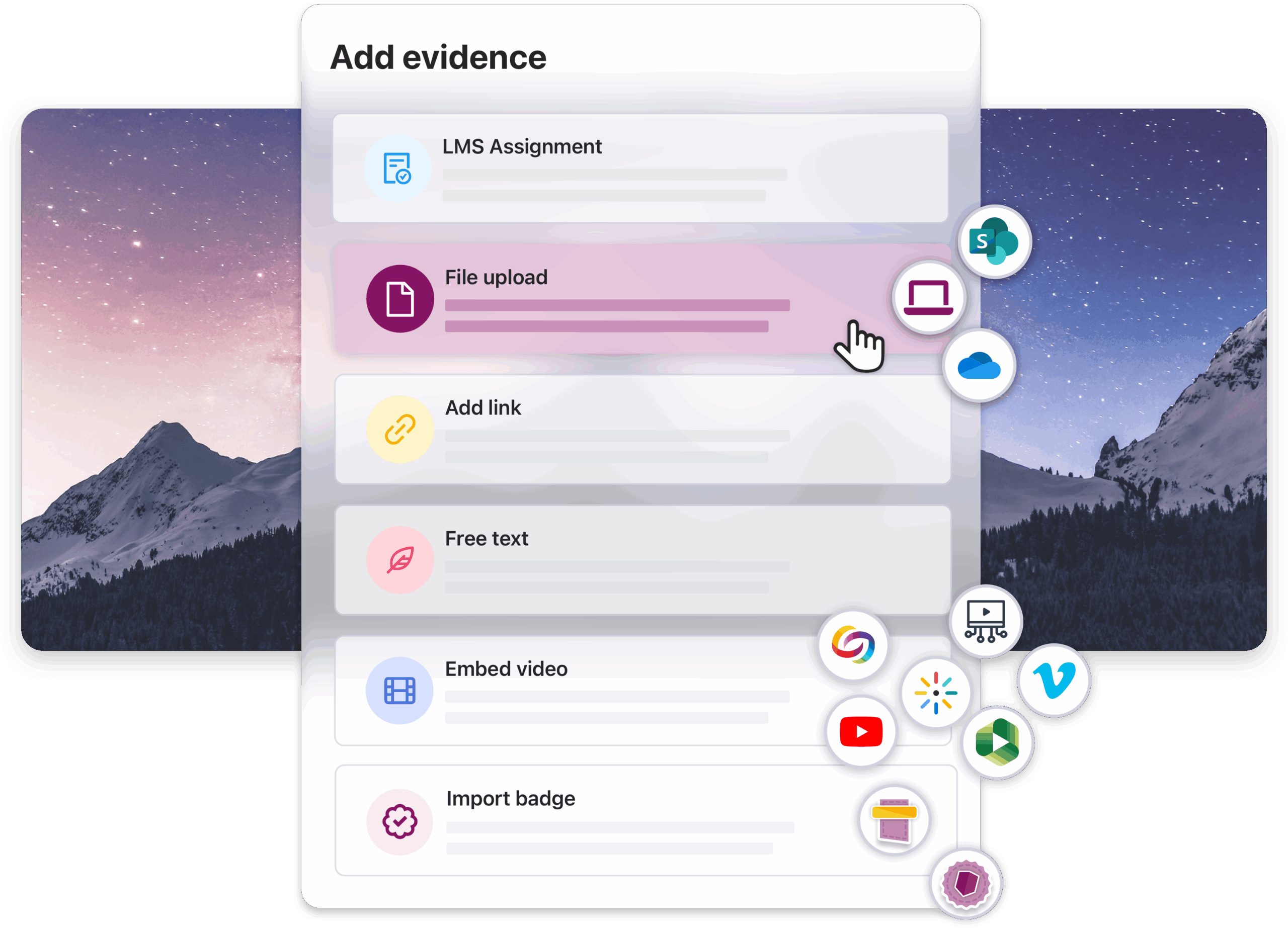
That same logic carries into the framework’s call for a broader mix of assessment and a better balance between formative and summative approaches. If learning is meant to unfold across stages, students need room to build, revise, and improve before they are finally assessed. Portflow supports that journey through version management, feedback requests, and the ability to create a locked snapshot for formal submission. In practice, this means formative development and summative judgement can sit within the same learning journey instead of being split into disconnected activities.

One of the most direct connections appears in the framework’s reference to journals, e-portfolios, vlogs, and blogs as valuable assessment media in an AI-shaped context. That matters because these formats help surface critical thinking, decision-making, and reflection more clearly than a polished output alone. Portflow supports this by giving students space to curate artefacts, add reflection, structure collections around different learning contexts, and build a record of growth over time. This direction also aligns with Jisc’s recent assessment trends report, which identifies portfolio and process-focused assessment as part of the sector’s response to digital transformation and generative AI, alongside wider interest in programme-level redesign.

The framework also places real value on reflection, peer learning, collaboration, and teacher-student interaction. Here, too, the link is practical. Students can request targeted feedback on evidence, collections, or their goals or outcomes, discuss it through threaded comments, and link feedback back to goals so it becomes part of their development rather than a one-off response. They can also share parts of their portfolio with peers or invite feedback from external contributors, such as placement supervisors. This makes assessment more dialogic, more authentic, and more visibly grounded in actual engagement.


Finally, the framework keeps alignment with programme and module learning outcomes at the centre, while also pointing toward the development of lifelong learners. Portflow supports that by helping students and educators connect evidence and feedback to outcomes over time, while also allowing students to retain access for continued use after graduation. That gives learning evidence a longer life than a single module or assessment event and fits perfectly with the framework’s wider view of development, continuity, and learning beyond university.

Why do visibility and coherence matter in programme-level practice?
A key strength of the framework is that it does not treat assessment redesign as something that can be solved one module at a time. It makes clear that in response to GenAI, redesign needs to be considered more holistically at the programme level, so that assessment remains coherent, fair, and aligned across the student journey.
That matters because programme-level redesign is not only about changing individual tasks. It is about creating a balanced assessment pattern across stages, avoiding over-reliance on vulnerable formats, and giving students a clearer and more consistent idea of what is expected of them. The framework is especially clear that students should not encounter fragmented approaches to AI use, assessment design, and feedback from one module to the next.
This is where tools that support visibility and continuity become important. If institutions want assessments to feel coherent across a programme, they need ways to carry evidence, reflection, feedback, and progress across time rather than leaving them trapped within separate modules. Portflow helps make that more possible by giving students and educators a shared space where development can be followed across modules and other learning contexts, with stronger links between learning evidence, feedback, and outcomes.
That kind of continuity also matters for staff. The framework notes that programme-level coordination can reduce the burden on individual lecturers by encouraging shared approaches, cross-module collaboration, and more collective decisions about assessment design. In that sense, visibility is not only a pedagogical advantage, but it also helps reduce the (administrative) burden on lecturers
Ultimately, visibility and coherence matter because they improve both the student experience and the institution’s ability to make redesign stick. Clearer expectations, stronger continuity, and a more joined-up view of learning make assessment easier to understand for students and easier to sustain for educators. That is what turns redesign from a set of isolated responses into a more meaningful institutional practice.
What can higher education institutions learn from this?
The framework makes one thing especially clear: the response to generative AI cannot stop at detection, restriction, or isolated changes to individual assessments. What higher education institutions need is assessment that is better designed from the start, with greater visibility of learning, stronger emphasis on process and reflection, and clearer coherence across modules and programmes. That is also why tools like Portflow matter in this conversation. What makes Portflow relevant in this context is its ability to support the kind of assessment environment the framework is pointing towards, one where learning can be made more visible, feedback can travel across the process, and assessment redesign can be embedded more coherently across programmes.
Sources
Corbin, T., Dawson, P., & Liu, D. (2025). Talk is cheap: why structural assessment changes are needed for a time of GenAI. Assessment & Evaluation in Higher Education, 50(7), 1087–1097. https://doi.org/10.1080/02602938.2025.2503964
Farrell, H. (n.d.). 2026 Assessment Redesign Framework | GENAI:N3. https://arf.genain3.ie/index.html
GENAI:N3 – Gen AI: N-TUTORR National Network. (2026, February 16). https://genain3.ie/
O’Sullivan, J., Lowry, C., Woods, R., & Conlon, T. (2025). Generative AI in Higher Education in Teaching & Learning: Policy Framework. National Resource Hub (Ireland). https://doi.org/10.82110/073e-hg66
O’Sullivan, J., Lowry, C., Woods, R., Marrinan, B., Hutchinson, C., & Higher Education Authority. (2025). Generative AI in Higher Education Teaching and Learning: Sectoral perspectives. In Higher Education Authority. https://www.teachingandlearning.ie/gen-ai-sectoral-perspectives/
Quality and Qualifications Ireland (QQI). (2025). Generative Artificial Intelligence Survey Report. https://www.qqi.ie/sites/default/files/2025-08/generative-artificial-intelligence-survey-report-2025.pdf?utm
Walker, S. (2025, January 23). Trends in Assessment in Higher Education: Considerations for policy and practice. https://www.jisc.ac.uk/reports/trends-in-assessment-in-higher-education-considerations-for-policy-and-practice
About the Author: Yas Farahani