Today’s learners move between education, work, and upskilling throughout their lives. For continuing education institutions, supporting these changing journeys brings new opportunities, but also new challenges. How can institutions offer greater flexibility while keeping their programs, processes and systems connected?
Imagine a learner named Sarah. She is a working adult who has taken a few courses, picked up skills on the job, and earned a certificate and a couple of microcredentials along the way. She will probably change direction several more times in her career. Her path is not unusual. For most adult learners today, it is the norm.

The research points the same way. According to the World Economic Forum’s Future of Jobs Report 2025, 39% of workers’ existing skills are expected to change or become outdated by 2030, and 63% of employers identify skills gaps as a major barrier to business transformation. Georgetown University research (Carnevale et al., 2023) projects that 72% of all jobs in the US will require training by 2031. The OECD’s Education Policy Outlook 2025 describes adults as moving into “more non-linear careers.”
But as institutions expand their offerings and serve more learners, they also need to manage increasingly complex programs, enrollment processes and learner journeys. How can they support this growth without adding unnecessary administrative work or compromising the learner experience?

Supporting non-linear learning journeys creates new complexity for institutions
As continuing education institutions expand their offerings, they also need to manage more programs, different learner needs, and an increasing number of systems and stakeholders.
This creates challenges across several areas:
- Program management: Managing hundreds of courses and programs across different formats, durations, and cohorts, including stackable courses and certificates.
- Learner administration: Supporting new and returning learners, different enrollment models, pricing and discounts, and employer-sponsored training.
- Institutional coordination: Working across departments, finance teams and other stakeholders, each with their own processes and reporting requirements.
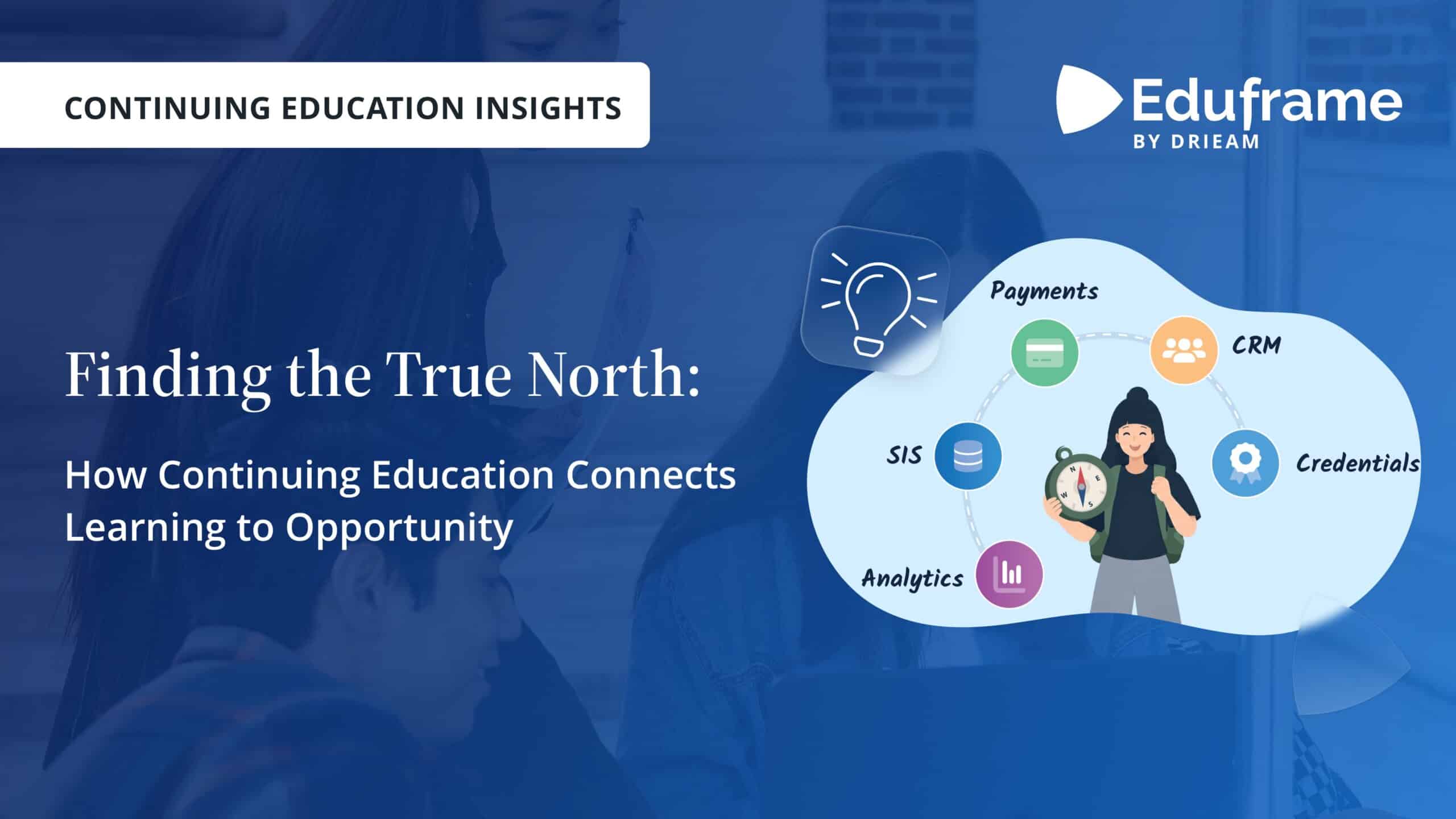
- Technology and integrations: Connecting student information systems, CRM platforms, credentialing tools, and other systems needed to support continuing education.
The result is that continuing education is often asked to scale on top of disconnected systems. According to UPCEA’s State of Continuing Education 2026, only 27% of continuing education units say their technology integrates seamlessly with main-campus systems.
While managing the learning journey of one learner like Sarah may be relatively straightforward, supporting 5,000 learners, each with different needs and learning pathways, becomes much more challenging.
For institutions looking to grow their continuing education offerings, the challenge is therefore not just attracting more learners, but ensuring their processes and systems can support that growth without adding unnecessary administrative complexity.

More learning opportunities don't always lead to learner progression
While institutions are expanding their learning offerings, completing more courses or earning more credentials doesn’t necessarily mean learners can build on what they’ve already achieved.
Take Sarah, for example. Over the years, she has completed several courses, developed new skills, and earned different credentials. But when she wants to take the next step in her education, she may find that her previous learning isn’t recognized or doesn’t contribute toward a larger qualification.
This raises important questions for learners. Will their previous learning count? Can individual courses contribute toward a larger qualification? Will another institution recognize their achievements? And can employers understand the skills they’ve developed?

Credit transfer shows how often the answer is no. According to Start From Yes, a 2026 joint statement from AACRAO and Sova, 4 in 10 adult Americans report attempting to transfer credit. Of those, 65% report a negative experience, and 16% report abandoning their college plans because transferring was too difficult.
Each of those numbers represents a learner who wanted to keep going and ran into a closed door. It also represents an institution that lost a learner it had already earned.
For continuing education institutions, this highlights an important challenge. It’s not just about offering more courses and credentials, but also about helping learners understand how their learning experiences connect and how they can build on them.
By creating clearer pathways between learning opportunities, institutions can make it easier for learners to continue their education and work toward their longer-term goals.

Four principles for connecting learning to progression
Four principles can help learning experiences connect, accumulate, and stay meaningful as learners move between education and work.
To help learners build on their previous achievements, institutions can focus on four principles that support more connected and flexible learning pathways.
- Stackability: Allowing learners to complete individual courses or modules that can contribute toward a larger certificate or qualification.
- Mobility: Making it easier for learners to carry their achievements between institutions and into the workplace.
- Comprehensive Learner Record (CLR): Bringing together different learning experiences and achievements to provide a more complete overview of a learner’s skills and qualifications.
- Portfolio: Giving learners a way to demonstrate the knowledge and skills they’ve developed, beyond simply listing completed courses or credentials.

Together, these principles can help institutions create clearer pathways for learners like Sarah, making it easier to understand how their previous learning contributes to future educational and career opportunities.

How institutions are connecting learning to progression
Institutions are taking different approaches to supporting more connected learning journeys. The following three examples show how Eduframe helps institutions address different challenges and support their learners.
UC Merced: Responding to changing workforce needs
The University of California, Merced, through its Division of Professional and Continuing Education (PACE), focuses on developing programs that respond to the needs of local communities and employers.
Through market research, community input, and strategic partnerships, UC Merced identifies opportunities for new programs and adapts its existing offerings based on employer demand, enrollment trends, and program performance.
This approach helps the institution keep its continuing education offerings relevant as workforce needs evolve. UC Merced has achieved an 81% increase in enrollment and a 28% increase in certificates awarded.
UChicago Professional: Creating a more connected learner experience
At UChicago Professional, the focus is on making the learner journey as straightforward as possible, even when multiple departments and systems are involved behind the scenes.
From discovering and choosing a course to registering, paying, learning, and returning for another program, each step is considered part of the same experience.
By connecting these processes, the institution aims to reduce friction for learners while making it easier for staff to manage the administrative work involved.
Jones College: Building stackable learning pathways
Jones College’s Online Workforce College takes a different approach, focusing on flexible, workforce-aligned learning pathways.
Rather than requiring learners to complete an entire program before receiving recognition, individual modules can be combined into larger learning pathways. Learners earn badges as they progress, allowing them to demonstrate the skills they’ve developed at each stage.
For example, a learner developing welding skills can complete smaller modules and earn recognition along the way, with each achievement contributing toward a broader learning goal.
With more than 800 modules, 280 pathways and approximately 190,000 badges issued, Jones College demonstrates how institutions can offer flexible learning opportunities while supporting workforce development at scale.
While each institution takes a different approach, they share a common goal: making learning more relevant, accessible, and connected, so learners can build on their achievements and continue progressing toward their goals.

Learner progression requires the right continuing education ecosystem
As continuing education institutions expand their offerings, they need technology that can support their specific requirements while remaining connected to the wider institution.
This means having systems that can:
- Support continuing education needs: Manage different program types, flexible enrollment models, pricing structures, and returning learners.
- Connect with existing institutional systems: Integrate with the institution’s LMS, CRM, SIS, and other tools, while allowing continuing education departments to manage their own processes.
- Support growth without increasing administrative work: Make it easier to manage more learners, programs, and partnerships without a proportional increase in manual tasks.
- Adapt to changing needs: Give institutions the flexibility to introduce new programs, adjust existing offerings, and respond to changing learner and employer demands.

Institutions are increasingly adopting a combination of specialized systems to meet these needs. According to ListEdTech’s 2026 report Best of Breed versus Best of Suite, 22% of institutions now use best-of-breed technology ecosystems, compared to 14% in 2019. Among large institutions, 59% use multiple vendors.
While technology alone cannot solve every challenge around learner progression, having connected and flexible systems provides an important foundation. It allows institutions to focus less on managing disconnected processes and more on creating learning opportunities that learners can continue to build on throughout their education and careers.

Where should institutions begin?
Improving learner progression doesn’t necessarily require institutions to change everything at once. A good starting point is to understand where learners experience challenges and where existing processes could be improved.
Start by mapping out a typical learner journey, from discovering a course and registering to completing it and potentially returning for further education. Identify where learners might encounter difficulties or drop off along the way.
It’s also important to look at the administrative work happening behind the scenes. As we explored in our article Before Investing in New Technology, Start with People, even ten minutes of manual work per registration adds up to more than 166 hours across 1,000 registrations.
Once you’ve identified these challenges, consider what’s causing them. Is it a lack of information, complicated registration or payment processes, disconnected systems, or difficulties recognizing previous learning?
Three questions can help guide these discussions:
- Where do learners encounter challenges when moving from one learning opportunity to another?
- Can learners build on their previous learning and use their achievements toward future qualifications?
- Do our existing systems and processes support learners throughout their journey, including when they return for further education?
Institutions don’t need to solve all these challenges at once. By identifying opportunities for improvement and addressing them step by step, they can create a more connected learner experience while reducing unnecessary administrative work.
Ultimately, the goal is to make it easier for learners to find relevant opportunities, build on what they’ve already achieved, and continue developing their skills throughout their careers.
How can Eduframe support a more connected learner journey?
While technology alone cannot solve every challenge around learner progression, having the right systems in place can help institutions offer more flexible learning pathways, improve the learner experience and reduce administrative complexity.
Eduframe by Drieam is the Student Information System (SIS) and registration platform purpose-built for continuing education. It helps institutions manage and grow their continuing education offerings while connecting with their existing technology ecosystem.
With Eduframe, institutions can:
- Boost enrollment: Showcase courses and programs through a branded online storefront, making it easier for learners to discover learning opportunities, register, and pay online.
- Save staff time: Streamline course and learner administration, automate repetitive tasks, and manage enrollments, scheduling, payments, and certificates from one platform.
- Improve the learner experience: Connect registration, learner administration and course delivery through integrations with Canvas LMS and D2L Brightspace. Learners can also access their courses, progress, results, and certificates through a dedicated student portal.
- Support flexible learning pathways: Offer stackable courses and programs that allow learners to start with individual courses and build toward larger qualifications.
- Connect existing systems: Integrate Eduframe with institutional websites, CRM platforms, payment providers, and other applications through out-of-the-box integrations and an open API.
By bringing these processes together, Eduframe helps institutions scale their continuing education offerings without adding unnecessary administrative work.
For learners like Sarah, this means a more connected experience, from discovering and registering for a course to tracking their achievements and returning for further education. For institutions, it provides the flexibility to support different learning pathways while managing their programs and learners more efficiently.
Supporting more connected learning experiences is also a priority across the wider continuing education community. As an active UPCEA partner, Eduframe by Drieam was proud to return to UPCEA Convergence 2026 as a Silver Partner for the fourth year. It was an opportunity to connect with continuing education leaders, discuss the challenges of supporting lifelong learners, and share how Eduframe helps institutions grow their offerings, simplify administration, and connect their existing systems.
About the Author: Egle Talandyte