
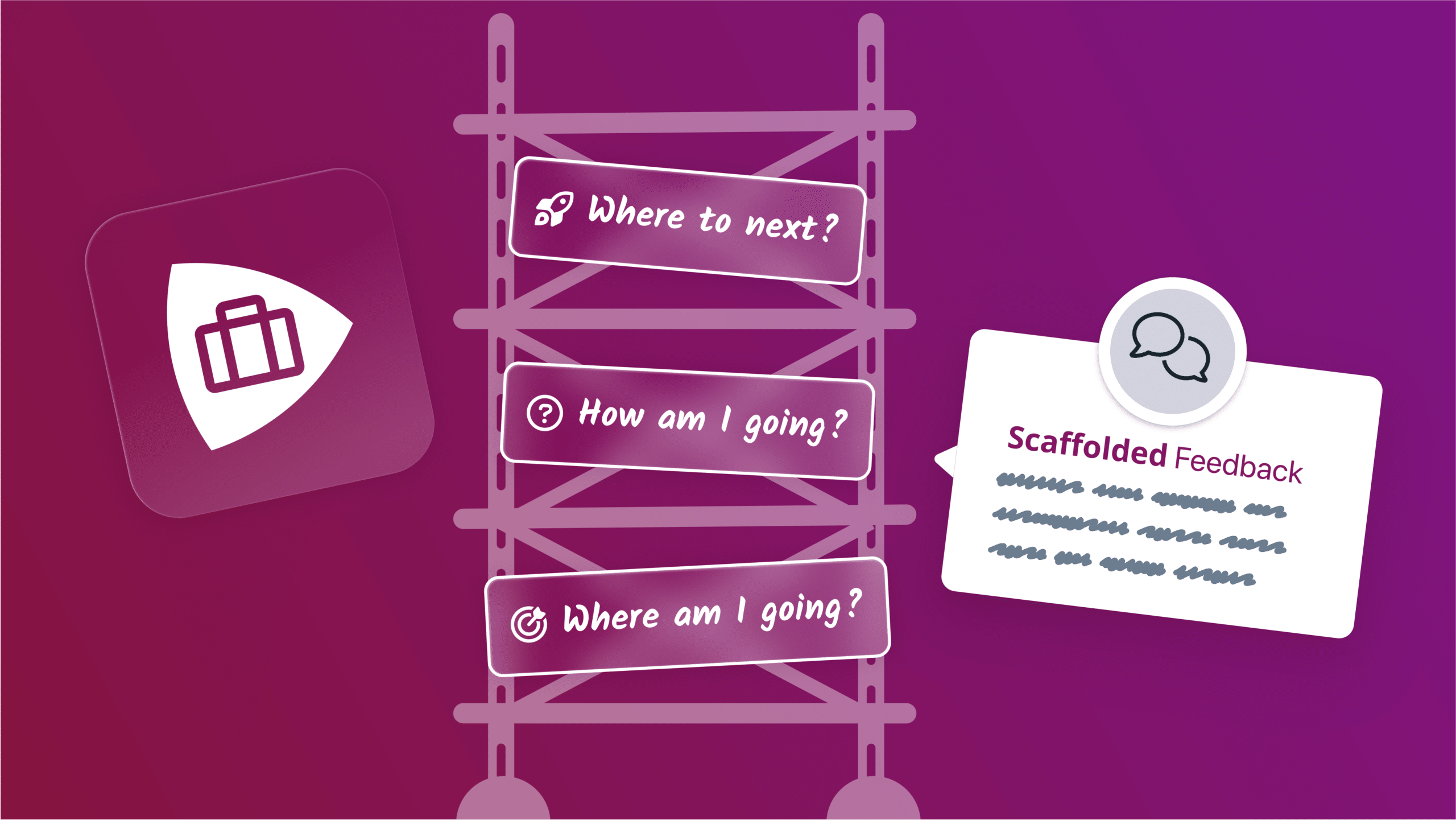
Feedback is a double-edged sword: Done right, feedback has one of the most powerful influences on learning. Done wrong, it can cost a lot of time but have little impact, or even negative impact on (deeper) learning. Requesting and providing feedback that has a positive impact requires a lot of skill: the right timing, type, and level are essential. As a coach, you can scaffold the feedback process to teach learners effective feedback strategies, and contribute to an efficient and impactful feedback loop.
The double-edged sword of feedback
While feedback has major potential to positively impact sense of ownership, satisfaction, and learning yield, this potential is not realised in practice. In national surveys, we find that learners are insufficiently satisfied with their received feedback, while a lot of time and effort goes into feedback from both learners and teachers alike. In national student surveys (such as the UK National Student Survey 2025 and Dutch Nationale Studenten-Enquête 2025), ‘Assessment and Feedback’ continues to rank below general teaching quality and learning resources in terms of learner satisfaction.
A critical bottleneck seems to be learner feedback literacy (Malecka et al., 2022). When learners are taught how to formulate specific feedback requests that actually help them improve their work, and a better feedback loop follows, learning yield and satisfaction both improve significantly (Hattie & Timperley, 2007).
Where does traditional feedback fall short?
Traditionally, feedback is implemented at the end of a learning activity, providing mostly substantiation for judgement (grading). The feedback is given, but is it received? Backfilled feedback does not provide any opportunity to interact with and apply. When we shift from backfilling to front-loading feedback, we achieve a win-win-win: workload for teachers is levelled over time, feedback is focussed on the levels and types that have more impact (e.g. process feedback instead of product feedback), and learners get the chance to implement feedback and therefore learn deeper.


Good feedback that meets requirements such as correct timing, type, and level is not easy to request nor easy to provide. Often teachers and learners fall back on giving or requesting a list of corrections on a specific piece of evidence or praise the learner as a person (task level or self level), instead of focussing on learning strategies (process level or self-regulation levels). Traditional feedback focuses on what has happened (feed-back), instead of on where we are going and how it is going (feed-up and feed-forward).
If we can model and teach what an ideal feedback process looks like, learners can develop their self-regulating learning behaviours. These self-regulating skills positively impact the rest of their learning journey.
Better feedback in practice
To allow learners to take ownership over the feedback process, yet still guide learners to do the right things at the right time, Portflow utilises teacher-suggested content called Snippets. Feedback Snippets are curated by learning designers and distributed with a code or searchable by name. Snippets can help learners structure their feedback request, nudging the learner to include a specific focus question or format. A learner can also suggest a Feedback Snippet for their invited responders, to suggest a format in which they wish to receive their feedback.
Feedback in Portflow is an ongoing reflective process, not a list of corrections that a learner works through. A good initial feedback question helps eliminate unproductive back-and-forth, and to get to the actual question on the right cognitive level.
How to use Feedback Snippets in Portflow?
Learning designers get the Snippet Creator role in Portflow. They can then create public or private Feedback Snippets. Private Snippets specifically apply to certain people and can only be found with the code, public Snippets are widely applicable and can be used by anyone within the institution.
When learners start their feedback request, they can select a Snippet to use whilst creating their request, and suggest Snippets to the responder: a Snippet for general feedback and a Snippet for goal-specific feedback.
Co-creation
These new features have been developed in collaboration with our educational partners, such as Fontys, HvA and ECU. Thanks to fruitful discussions and an iterative approach, we have jointly identified the key practical needs of users involved in teaching self-regulated learning behaviours. This has enabled Portflow’s product team to develop this feature, which allows you to scaffold feedback behaviour in Portflow.
Want to find out more?
Ready to help learners ask for feedback more effectively? Take a look at our knowledge base articles on creating Feedback Snippets and requesting and providing Feedback.
Sources & Further reading
Hattie, J., & Timperley, H. (2007). The Power of Feedback. Review of Educational Research, 77(1), 81-112.
Malecka, B., Boud, D., & Carless, D. (2022). Eliciting, processing and enacting feedback: mechanisms for embedding student feedback literacy within the curriculum. Teaching in Higher Education, 27(7), 908–922. https://doi.org/10.1080/13562517.2020.1754784

About the Author: Naomie Amsing