The term “stackable” has become a buzzword in continuing education, promising a new era of flexibility for lifelong learners. UPCEA even refers to it as ‘the future of higher education’.
But what does it really mean to have a “stackable credential”? Is it the ultimate solution for a modern, agile workforce, or is it a slippery slope toward fragmented, disjointed learning? This blog post delves into the true implications of stackable credentials, exploring their promise, pitfalls, and the practical considerations for both institutions and learners.

What Are Stackable Credentials?
At its core, the meaning of stackable credentials is simple: they are smaller, standalone learning units that can be combined or “stacked” to build toward a larger qualification, such as a degree or a larger certificate.
From a learner’s perspective, they represent a flexible, bite-sized approach to upskilling. Instead of committing to a multi-year degree program, a professional can earn a stackable micro credential in a specific skill (e.g., a certificate in data analytics) and later apply that credit toward a full stackable graduate certificate or even a master’s degree. This allows for just-in-time learning, enabling individuals to acquire the skills they need for their current job while keeping their long-term educational goals in sight.
For institutions, stackable credentials in higher education are a way to meet the evolving needs of adult learners. They can attract a new demographic of students who may not be able to enroll in a traditional program and can create a more modular, responsive curriculum. So, when implemented in the right way, bite-sized (stackable) credentials can become a substantial revenue stream for institutions.


How Do Stackable Credentials Contribute To Flexibility For Learners?
Microcredentials complement traditional for-credit educational programs in a couple of different ways:
- Accessibility and Affordability: Smaller learning units are often more affordable and require less time commitment, making them accessible to a wider range of learners.
- Career Agility: Learners can acquire specific, in-demand skills quickly and apply them immediately in their professional lives.
- Trial-and-Error Learning: Individuals can test out a field of study without committing to a full degree, reducing the risk of a poor fit.
Making microcredentials stackable allows learners to create their own personal Lifelong Learning Pathways: the learner can continuously add new skills and qualifications throughout their career, creating a dynamic, personalized learning journey.
That’s why the promise of stackable credentials for lifelong learning is an important one: they are an essential part of making professional education available for the workforce and enriching their skillset throughout their entire career.
Also read: Who Is the Lifelong Learner? Expanding the Definition of Today’s Learners

What Are The Benefits of Stackable Credentials for Institutions?
For institutions, offering microcredentials has some clear advantages. Amongst other things, it allows them to make a clear contribution to labor market participation, to remain competitive with peer institutions and to generate new revenue streams. Microcredentials can also be brought to market quickly, allowing institutions to respond quickly to a rapidly changing labor market.
Furthermore, making modules ‘stackable’ means learners have a stronger incentive to return and take additional modules with the goal of obtaining a credited degree in the end. Investing in stackability, therefore, also means investing in a long-term relationship with your participants.

What Are Potential Pitfalls of Stackability for Institutions?
When the offering of stackable continuing education modules is properly designed, the benefits for both students and institutions are evident. However, a couple of risks loom when the various components are insufficiently coordinated:
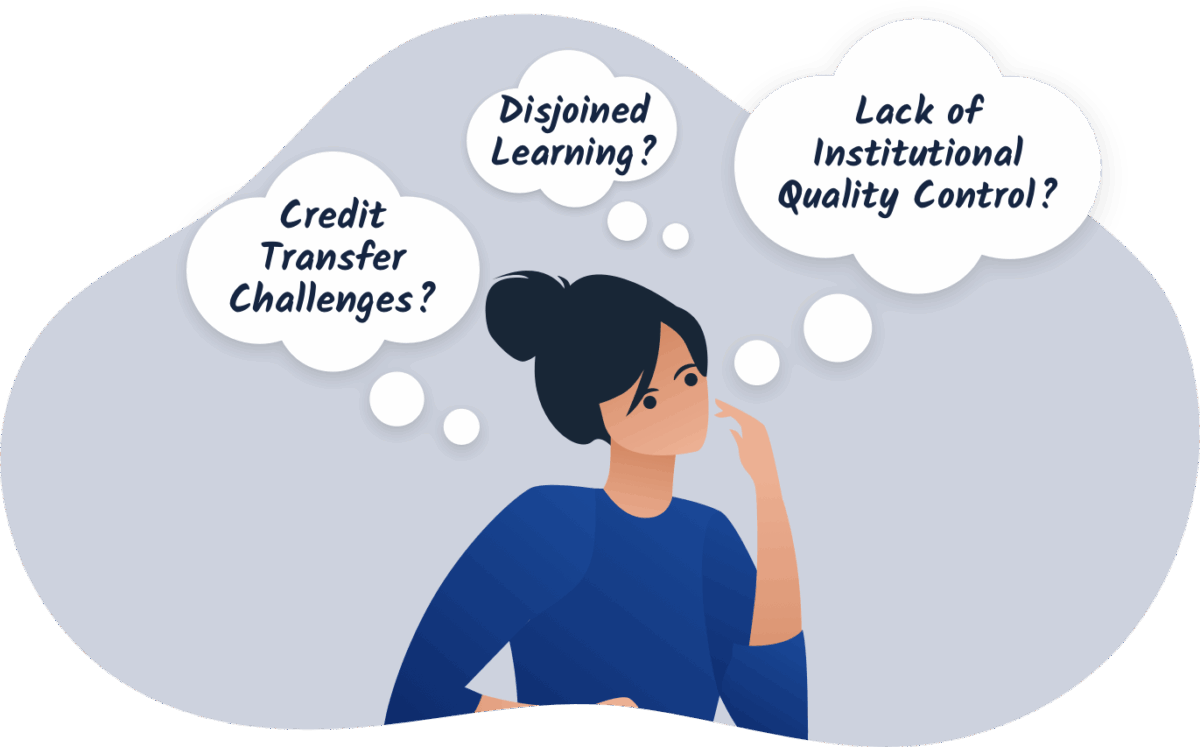
- Disjointed Learning: Without a thoughtful design, a series of stacked credentials can feel like a collection of disconnected modules rather than a cohesive learning experience. This can lead to knowledge gaps and a lack of a holistic understanding.
- Credit Transfer Challenges: While the concept of “stacking” sounds simple, the reality of transferring credit can be complex. Institutions must have clear, transparent policies to ensure that a credential earned at one point can truly count toward a larger one later on.
- Lack of Institutional Quality Control: When credentials are too small or are developed in isolation, there is a risk of a loss of the rich, interdisciplinary learning that a full degree provides.
To surpass these pitfalls, institutions should pay close attention to the way in which they design the different learning pathways, both content-wise and from an organizational perspective.
Also read: Cross-Border Insights: Scaling Alternative Credentials for Lifelong Learning

How To Design Cohesive Pathways Using Stackable Credentials?
To truly harness the potential of stackable credentials, institutions must be intentional about their design. The goal is not just to offer a series of courses but to create a cohesive, meaningful learning journey. Three key things to consider here:
- Map the Pathway: Institutions should clearly define the progression from a micro-credential to a full degree. This involves creating a “credit map” that shows how each smaller unit contributes to the larger qualification.
- Focus on Learning Outcomes: The design should be guided by learning outcomes. Each credential should build on the previous one, with a clear progression of skills and knowledge.
- Create Bridges, Not Silos: Ensure that the curriculum is integrated. This might involve capstone projects that synthesize knowledge from multiple credentials or a dedicated advisor who helps students navigate their learning journey.

How About Stackability & Portability of Credentials Between Different Institutions?
While stackability offers a great promise, it is still largely unproven in practice, as Glenda Morgan from Phil Hill & Associates argues in her 2024 blog post. In part, this is caused by a lack of portability of these microcredentials from one institution to another.
That is why some higher education institutions and accrediting bodies are working on common standards or badging systems that would make it easier to verify and transfer credits from various sources.
The most notable example might be 1EdTech’s Digital Credentials Ecosystem, that consists of – amongst other things – a Comprehensive Learner Record (CLR); a personal and verifiable learning and employment record supporting all academic and workplace recognition and achievements, including courses, competencies, skills, and employer-based achievements and milestones. Such standards are likely to facilitate true and universal ‘stackability’ and ‘portability’ in continuing education in the future.

Stackable Credentials in Action: Jones College Online Workforce College (OWC)
Online Workforce College, based out of Jones County Junior College in Mississippi is a fully-online, self-paced learning platform. OWC offers over 800 learning modules that cost around $10 each. Over the past couple of years, they’ve been able to award over 130,000 skills microcredentials to over 11,000 learners across South Mississippi – with a team of only two people.

Example of a coherent badging structure at Jones College Online Workforce College: The full program ‘Project Management’ consists of multiple microcredentials that can be taken separately.
Several key factors have contributed to this success:
- OWC has established a clear badging structure where multiple individual modules together form a coherent, credited program (see example above). This allows students to easily decide for themselves whether and when to take multiple modules from the series and thus obtain a full diploma. Furthermore, each completed module immediately adds value for the student, as they receive proof of completion from a renowned institution.
- The content of the stackable microcredentials is coordinated and designed in consultation with partners in the field. For example, OWC collaborates with employers and industry organizations to ensure that the course content remains relevant to professional practice.
- OWC uses Eduframe as a student information system and storefront for its workforce courses. Eduframe reduces the administrative workload for the institution by automating payment transactions, invoicing, and communication, simplifying course management, and centralizing course scheduling. It also offers a clear participant portal for students, allowing them to easily monitor their progress and encourages continued learning.
- By having a very clear data structure, OWC has been able to create their own version of a CLR which then also makes it a lot simpler for the learners to also seamlessly enter Jones College’s full programs.
This makes OWC living proof that stackable (micro)credentials can be a fruitful addition to traditional education.
Also read: OWC’s Full Case Study – Scaling Continuing Education Programs with Limited Resources
Conclusion
The future of education is modular, and stackable credentials are at the forefront of this shift. They offer a powerful solution for flexibility and lifelong learning. However, their success hinges on a commitment to quality and a thoughtful, intentional design. By moving beyond the buzzword and focusing on creating cohesive, meaningful pathways, institutions can ensure that “stackable” truly means flexibility, not fragmentation.
About the Author: Boy Janissen