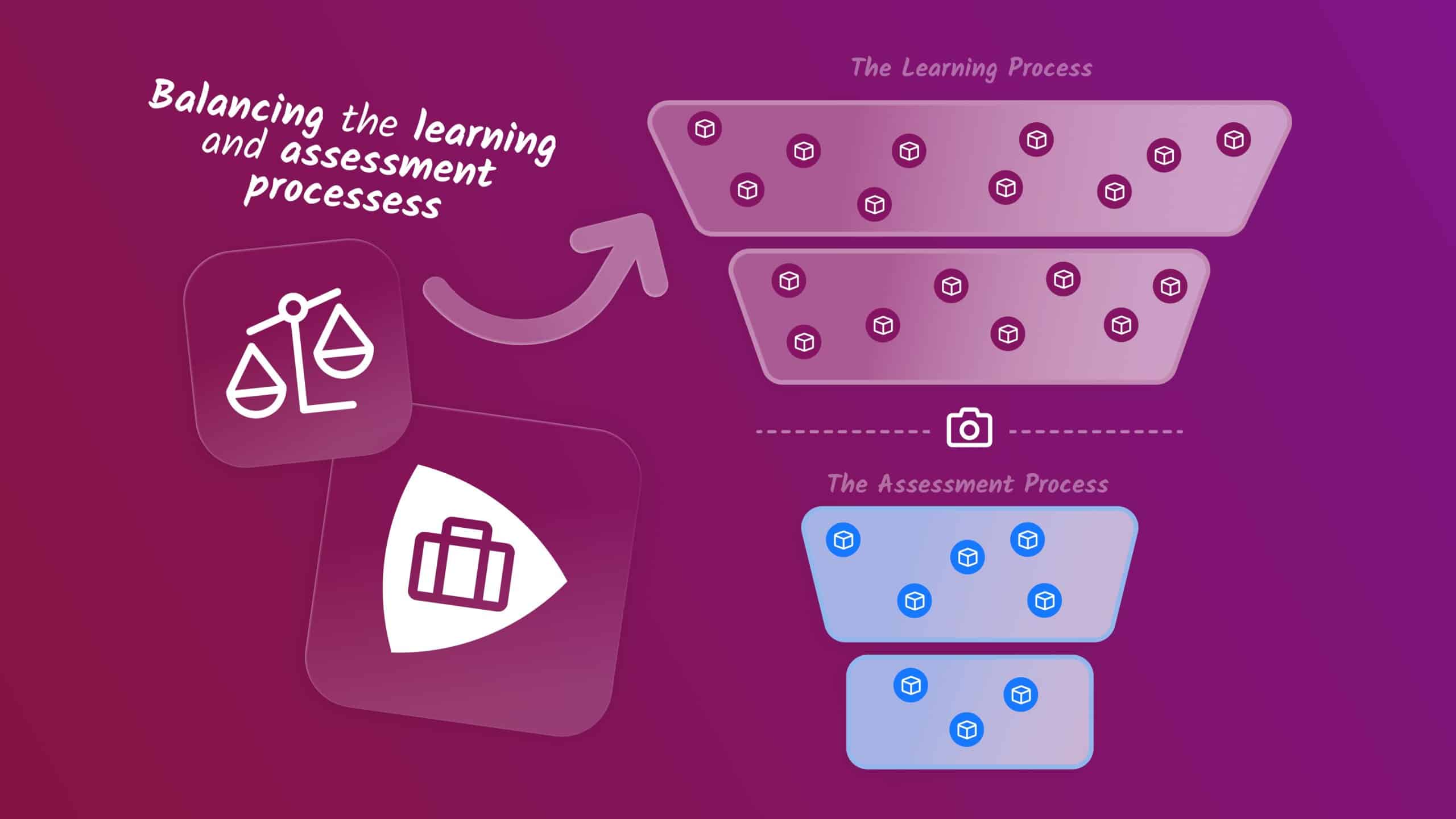
Development portfolios, which will also be used for assessment, are just assessment portfolios in disguise. Learners won’t feel the freedom to follow their curiosity and instead play it safe. Development and assessment portfolios are by their very nature in conflict with each other (Barrett, 2010). In Portflow, we combine the two by strictly separating them: learners can curate an assessment portfolio (Snapshot) from the materials within their catch-all development portfolio. By separating the process of collecting from the process of presenting, and using scaffolded Snapshots to bridge the gap, we protect learner curiosity and serendipity while smoothing the transition towards assessment.
Learning is like travelling. You might know the destination, have booked a plane ticket and pinned a few sights to see, but you don’t know who you will meet and who you will be when you get back home. In learning, equivalently, you know the competencies required for the profession you are training for and the learning activities that are part of the curriculum, but you don’t know who you will be at the end of your learning journey.
The process of Collecting vs Presenting
During the boat ride, you tuck your ferry ticket in between the pages of your journal, and you jot down a note about the person you met during dinner yesterday. You have no idea if these artefacts will become key moments in your life story later on. This is also not important when writing in your journal.
Development portfolios should be like your travel journal: collecting experiences, whether they directly prove something or not. Preparing for assessment is not the point in this phase. In fact, overthinking the end result dilutes creativity and hinders learning (Barrett, 2010). This is because a learner decides on different next steps when they focus on assessment instead of following their curiosity: they play it safe to prevent getting penalised for mistakes. But mistakes are the point, since they are essential in learning (Steuer et al., 2024). Learners should gather a portfolio of errors, without fear of failure: the development portfolio should be positioned and experienced as a safe place to fail.

What is learned from the curation process?
It takes a little distance – unpacking your luggage, emptying your pockets before laundry, and telling stories to your friends – for the dust to settle. You get a clear sense of the memories that matter and the moments that best tell your story. These stories get their place into the photo album, and the travel journal containing the raw memories goes back to the bookcase.
The process of curation and reflection is, in itself, a valuable learning moment (Barrett, 2011). This is when the learner can identify trends and discover their learning story. Curating an assessment portfolio for a high-stakes submission is intimidating and does not always lead to an immediate clear view. Without guidance, learners can either over-share (dumping every file) or under-share (missing key evidence of learning outcomes).
By scaffolding the curation process to include relevant resources, but keeping focus on the key points, curation and assessment become much smoother for learners and assessors. Additionally, learners have the chance to learn more from the curation process and reflect more deeply on their choices.
How does scaffolded curation work in practice?
Creating these Snapshots in Portflow is now easier by using a scaffold prepared by a teacher or learning designer. A learner can tell their story ‘from the beginning’ of starting to work on a learning outcome (Repository Goal) up until now. Learners can also create a Snapshot to tell a story for a specific part of a scaffolded learning journey (Template). In both these scenarios, a learner is always in charge of which materials they include or exclude in their Snapshot. The scaffold merely proposes suggestions from their teacher.
A teacher or learning designer does not need to specifically create a scaffold for Snapshots in Portflow. The existing Repository Goals or Templates can be used as Snapshot Scaffolds. A learner can select any set of Repository Goals and/or Templates to base their Snapshot of off. They can create this Snapshot either from the perspective of Goals (learning outcomes, competences, skills, etc.) or Collections (projects, modules, courses, etc.), whichever best fits their situation. This Snapshot can then be submitted in the LMS/VLE or grading system for assessment, while the learner sets off on their next adventure in their development portfolio.
Want to find out more?
Ready to scaffold the process of assessment portfolio curation? Take a look at our knowledge base articles on creating Repository Goals, Templates or Snapshots.
Sources & Further reading
Barrett, Helen. (2011). Researching Electronic Portfolios and Learner Engagement: The REFLECT Initiative. Journal of Adolescent & Adult Literacy. 50. 436-449. 10.1598/JAAL.50.6.2.
Barrett, Helen. (2010). Balancing the Two Faces of ePortfolios. Educação, Formação & Tecnologias, ISSN 1646-933X, Vol. 3, Nº. 1, 2010, pags. 6-14. 3.
Steuer, G., Tulis, M. and Peterson, E.R. (2025), Learning from errors and failure in educational contexts. Br J Educ Psychol, 95: 1-10. https://doi.org/10.1111/bjep.12723

About the Author: Naomie Amsing